Thursday, May 14, 2020

Enabling Accelerated Learning with Augmented Reality

Augmented reality (AR) is a technology that has applications in the education sector to simplify and accelerate learning about complex concepts. The technology adds a virtual layer in real-time within real world settings so learners can better relate to study topics. At Oodles Technologies, we receive similar AR Application Development Company inquiries from clients who want us to create interactive 3D 4D models for their learning solutions. Our AR/VR app developers use technologies like SparkAR to cater to their requirements.

Let's explore how Augmented Reality is impacting the education sector:-

 
Augmented Reality Classroom: The traditional classroom teaching methods were boring and it was difficult for the students to inherit the concepts easily. Students with different capabilities took longer to understand the concepts without practical demonstration. Augmented Reality (AR) technology uses 3D demonstration models to enable students to deeply understand the concepts in a virtually created environment. Augmented Reality Classroom training is highly beneficial for students with learning disabilities like Dyslexia, Dyscalculia, Dysgraphia. 

 
Star Walk: Constellation Finder: The app enables students interested in astronomy to explore the night sky. Using the app student can discover the stars, constellations, and other objects in the sky. Students can practically demonstrate the movement of stars and other celestial bodies in the night sky. 

The app is designed for the hidden artists. Students can not only color the picture but they can customize its design based on their capabilities. The tridimensional, realistic touch enables students to showcase their creativity and unleash the hidden artist within them. 

– AR has replaced traditional textbooks with 3D and 4D models to make learning materials easily accessible. The technology is less expensive and more interactive for the students to gain practical knowledge. Education can be made accessible to students in remote areas with the help of Augmented Reality classrooms. Schools are now using AR animated content in the classrooms to increase students’ engagement within the topic. Students can use AR-enabled headsets like Oculus Go to scan the elements of a book and receive audio, video, and text from the teachers. 

To make chemistry fun and engaging for the students, an AR app Elements 4D was released. The students have to first make paper cubes from the special element blocks. Then the students can add cubes in front of their device’s camera to check chemical elements representations, names, and their atomic weights. Students can bring the elements together to check what chemical reactions happen when two elements meet. 

The space industry has always been the first one to adopt advanced technologies. Astronauts use AR and MR to maintain a space station. AR goggles enable workers to receive visual work instructions without having to look at the manuals. NASA tested the Sidekick project in which HoloLens was used to give virtual instruction and illustrations to the crew members. Also, According to NASA, the technology can reduce crew training requirements.  

Medical Students Training: Augmented Reality technology can be highly beneficial for medical practitioners to perform surgeries in a virtual environment. The technology enables medical students to learn how to deal with real patients students inside the operation theatre within an artificially created environment.  

Augmented Reality Technology can be highly fruitful for the education and training of employees at offices and manufacturing industries. Incorporating AR at schools, colleges, and universities make the learning process easier and effortless. The technology concentrates on the retention of concepts to prevent the students from revision work. 

Looking for Augmented Reality solutions for your business? We are a well established AR apps development company that uses the power of Augmented Reality to learning easier and interactive. Get in touch with our experts for more details!  

Sunday, May 10, 2020

Building Mixed Reality and IoT Solutions Using Azure


Immersive applications, powered by next-gen technologies like augmented reality, virtual reality, and mixed reality are rapidly gaining traction worldwide. After successfully transforming various industries like gaming, entertainment, and advertising, these technologies are set to enter the mainstream market. Several retail brands and e-commerce companies are already using AR VR techniques to enhance their customer experiences. An increasing number of hotel and restaurant chains are training their staff using real-life simulations powered by virtual reality.

Owing to the increasing popularity of these immersive technologies, several small-to-medium companies are investing in AR app development services. At Oodles, we receive several requests for building different types of AR, VR, and MR applications. A majority of clients propose building a multifold application with a serverless architecture. To fulfill their requirements, we use several high-end AR VR tools as well as platforms Azure, Google, and AWS. 

In this blog post, we shed some light on the main benefits of using Azure Spatial Anchors for building high-quality augmented and mixed reality applications. 

What Is Mixed Reality?

A majority of users are familiar with terms like augmented reality and virtual reality because of their increased global popularity. However, there is a lot of misconception about mixed reality amongst users. Many users can’t discern the difference between virtual reality and mixed reality. Although the mixed reality is essentially the enhanced version of virtual reality, it has several unique characteristics. In broad terms, mixed reality combines virtual elements with the real-world environment to create an immersive three-dimensional space where physical and virtual objects co-exist. 


Building Mixed Reality Apps Using Azure Spatial Anchors

Azure Spatial Anchors is a fully managed cloud service from Microsoft that lets you build serverless mixed reality applications with cross-platform compatibility. Using Azure Spatial Anchors, developers can build high-quality applications for popular device platforms like Android, iOS, HoloLens, ARKit, and ARCore. Below are the main benefits of using Azure Spatial Anchors for building immersive mixed reality applications.

Creating Collaborative Experiences

With Azure Spatial Anchors, you can create immersive mixed reality experiences to collaborate with your peers in a more meaningful way. These collaborative experiences facilitate the study of complex elements and structures and provide an effective way to training staff. The mixed reality apps developed using Azure Spatial Anchors render support for a variety of devices such as HoloLens, ARKit-based iOS devices, and ARCore-based Android devices. You can develop apps using the native SDKs for the supported devices.
Building Mixed Reality and IoT Solutions Using Azure

Location-based Holograms

Azure Spatial Anchors lets you create engaging three-dimensional spaces with virtual elements interacting with physical objects. You can easily map the virtual spaces by connecting points of interest to engage your target audience. Azure lets you place location-based holograms with minimal environmental setup or QR codes. One can share these holograms across multiple devices.
Building Mixed Reality and IoT Solutions Using Azure

Infusing Artificial Intelligence and IoT Services

With Azure Spatial Anchors, you can easily integrate your application with next-gen technologies like artificial intelligence and machine learning. Besides, you can integrate the mixed reality applications with IoT services to access through your connected devices. It also lets you develop standalone IoT applications with MR-based features and capabilities. At the same time, you can safeguard your mission-critical enterprise data with Azure cloud support. 

You may also be interested in reading Things To Consider For Augmented Reality App Development

Closing Remarks

Azure Spatial Anchors is used by several companies, mainly to enhance their staff training programs. For example, Pearson Education has built a mixed reality solution using Azure that enables nursing students to perform complex health diagnosis in a real-world environment. Similarly, several educational institutes use MR applications to train aspiring surgeons by letting them perform virtual surgeries. 

Why Choose Oodles Technologies For AR Application Development?

We are a seasoned AR application development company that builds high-quality AR/VR and Mixed Reality applications with cross-platform compatibility. We use the latest tools and technologies to build immersive AR/VR/MR applications that maximize user engagement and interactivity. Our development team is skilled at using advanced tools and cloud platforms like Azure, AWS, and Google Cloud to build engaging AR/VR/MR applications with a serverless architecture. We also have our expertise in IoT application development and we provide seamless IoT integration for AR/VR/MR applications.

Friday, May 8, 2020

Benefits of Developing AR VR Apps with Amazon Sumerian


Our exposure to augmented reality (AR) and virtual reality (VR) applications has increased significantly in recent years. Organizations across industries see the potential of AR and VR apps for a range of uses including training and education.  They are integrating AR VR technologies to their web or mobile apps to generate curiosity in consumers for their products or services. AR, VR, and MR technologies provide a more immersive medium to engage with customers. Global consumer brands have shown a lot of interest in AR VR app development services since they were first introduced. Some notable instances of their adoption by technology leaders are as follows:-   

  • Amazon Web Services (AWS) launched the Amazon Sumerian toolkit in 2017 to enable app developers’ create and run interactive AR VR apps. 
  • Apple introduced an ARKit framework so that iPad and iPhone users can experience augmented reality (AR)
  • Microsoft uses Mixed Reality (MR) to merge virtual objects with the real world.
  • Facebook Spark AR Studio’s impressive tools create rich, relevant, and contextually-aware AR experiences to alter customers' decisions. 
A comparison table for building an AR VR app with and without Amazon Sumerian

Developing An AR VR App without Sumerian 
Developing An AR VR App with Sumerian 
Creating an AR VR app involves lots of complexities it starts: 
Step 1: Decide an idea
Step 2: Selecting the Framework
Step 3: Defining a platform
Step 4: Developing a platform
Step 5: Developing appropriate graphics
Step 6: Selecting and creating the backdrops. 
Last Step: Publish the app
Developing an engaging AR app with Amazon Sumerian is easy:

Step1: Decide an Idea
Step 2: Build an App with Sumerian 
Step3: Publish
Normal AR VR App Development
AR VR Apps with Amazon Sumerian

Amazon Sumerian provides an easy to use interface that provides the following benefits: 
No VR/AR Expertise Needed: The Sumerian toolkit enables developers to build apps using AR, VR, and 3D graphics without any specialized programming or graphic skills. With Sumerian editor, developers can create, edit, and publish applications using a web browser.  

Lifelike Characters: Using Sumerian developers can create interactive 3D characters. The animated life-like characters can speak to a user in a variety of languages to create a more personalized experience for them. In-built services, Amazon Polly and Amazon Lex solutions can script scenes using automatic speech recognition (ASR), natural language understanding (NLU), and text-to-speech.   

Design Immersive Environments: Sumerian enables developers to design scenes that immerse users in 3D, lifelike surroundings populated with animated characters. Developers can import 3D objects into different scenes or use third party offerings from repositories like Turbosquid and Sketchfab to create AR, VR, and 3D environments. 

Runs on Multiple Platforms: Sumerian is platform-agnostic. It is based on the WebGL JavaScript API for graphic rendering and WebVR JavaScript API for virtual reality devices. It builds and runs a scene on browsers that support WebGL or WebVR graphics rendering including Oculus Rift, Oculus Go, HTC Vive, HTC Vive Pro, Lenovo Mirage, Google Daydream, and mobile devices. It supports ARCore for Android devices and ARKit framework for AR on iOS devices. 

Facebook Spark AR tool is another perfect tool for creating interactive AR VR apps. Click this link to learn more on the capabilities of SparkAR toolkit: Enhancing Consumer Apps with Spark AR 

Sumerian Use Cases

  • Employee Education: Businesses are using Sumerian to create virtual classrooms to augment the training of their employees. Virtual scenes can be created to mimic the actual working environment to employees enabling them to absorb the concept faster. 
  • Training Simulations: AR technology can provide an ideal environment where personnel can learn new techniques without risking physical damage or loss. Employees can receive hands-on training in specialized fields like law enforcement, aviation, healthcare, or industrial machinery through build scenes simulating real-world scenarios. For example, Simulation can be created to train surgeons on using a new variety of surgical instruments. 
  • Field Service Productivity: AR can improve the productivity of employees in field related tasks. Interactive visuals produced with Sumerian can accelerate repairing, assembling, maintenance, and manufacturing processes. AR can enable technicians to look up schematics and accelerate their work in real-time. For instance, the AR app can demonstrate a worker on how to troubleshoot and repair machinery.
  • Virtual Concierge: Businesses can use Sumerian for creating scenes with a Host that acts as a concierge to their end-users. The concierge can greet users, answer common questions, and guide them through the company’s services and offerings. Users can even engage with the concierge through a smartphone in a completely virtual portal using a head-mounted display.   
  • Retail and Sales: Augmented Reality developers can create interactive apps using Sumerian for eCommerce platforms. Ikea Place is a leading online furniture store that utilizes AR capabilities to sell its products. The app augments users' decisions by virtually placing the products in their interiors. Businesses can use AR capabilities to train their sales team by creating virtual scenarios before they enter the main field. 


Benefits of VR, AR and MR technologies can be recognized by online and offline businesses.  These technologies play a great role in improving brand engagement, increasing business sales and profit.  Integrating AR, VR, MR with gaming apps or social media apps provides several interaction possibilities in a real-world setting. Creating a real-world environment for customers leads to a better online shopping experience, enriches learning and strengthens team collaboration.

Are you planning to upgrade your business apps with AR, VR and MR technologies? Talk to our software developers today. We are an AR app development company that builds robust and feature-rich applications for enterprises across the globe. We enable businesses from retail, real estate, and healthcare to incorporate AR, VR and MR technologies to provide immersive experiences. For more details contact our experts today!

Tuesday, May 5, 2020

Enterprise Benefits of Implementing Cloud Based IoT Solutions

The number of devices connected to the internet has increased tremendously over recent years. According to Comarch, the total number of connected devices is estimated to be a few times greater than the global population. This enormous growth is a direct consequence of the increasing popularity of the internet of things (IoT). A large number of businesses in all major industries like retail, finance, e-commerce, and agriculture are actively using a variety of IoT applications to streamline their communications. Not to mention, the telecommunication industry is amongst the top partakers of the cloud-based IoT technology.

According to Telecom Review, IoT is expected to generate $1.8 trillion in revenue for mobile network operators alone by 2026. To avail the maximum benefits of IoT, enterprises must invest in cloud application development and monetize their IoT resources accordingly. In this blog post, we’ll walk you through the key enterprise benefits of cloud-based IoT app development services.


What Is a Cloud-based IoT Solution?

Understandably, IoT is all about connecting various objects to facilitate frictionless communications and making act intelligently with no human intervention. At the same time, a cloud-based IoT solution breathes new life into IT services by improving the interaction between IoT devices. By combining cloud computing with the internet of things, enterprises do not have to deal with the complexities of managing IT infrastructure. 

Furthermore, it enables enterprises to optimize their IT performance and reduce operating costs. Apart from being cost-effective, cloud-based IoT solutions provide increased security, better data mobility, effective disaster recovery, and much more. Let’s move ahead and discuss in detail the main benefits of cloud-based IoT solutions.

Better Scalability

The on-premise IT infrastructures require complex hardware and software resources to scale their increasing inbound and outbound operations. Besides, it requires routine system checks, configurations, and performance optimizations to maintain smooth performance and reduce the instances of downtime. More problems arise while adding new hardware to the network that requires continuous configuration efforts from the technical team. 

Contrarily, a cloud-based IoT system makes it easy to add new resources to the network since there are no prevalent hardware complexities. Instead of configuring complex hardware infrastructure, you just have to purchase additional cloud space or lease a virtual server. As a result, it significantly reduces costs, complexities, and accelerates the process. Besides, integrating your IoT system with a cloud solution makes it easy to scale the increasing number of device interactions and information transfers. 

Increased Data Security

Security has always been a major concern with IoT devices. Since the connected devices are vulnerable to data breaches, third-parties can easily obtain users’ personal information. Several companies use information extracted from digital assistants and wearable devices to run personalized advertisements on various platforms. Understandably, many organizations may feel uncomfortable while sharing their sensitive data with third parties.

Not to mention, a cloud-based IoT system puts enterprises in control of their data which is adequately protected against breaches. In addition, you can avail regular software and firmware updates to avoid all types of malicious attempts to steal sensitive information. Several cloud platforms such as AWS, Azure, and Google Cloud also provide round-the-clock data monitoring to strengthen data security. 

Corporate Data Mobility

One of the most significant benefits of availing a cloud-based IoT solution is that you get seamless data access across devices. When your enterprise data is stored and processed in a cloud server, you can access it from anywhere across the globe. It brings optimum data mobility, implying that your enterprise data is not bound by any kind of network constraints. As a matter of fact, mobility is of foremost importance when it comes to IoT app development. Many IoT projects require real-time monitoring and management of connected devices where data mobility is essential. With a cloud-based IoT system, you get advanced tools to effectively manage, process, and update your device data remotely with minimal complications.

Reduced Time To Market

Upgrading the on-premise IoT systems to encapsulate new features and capabilities can be a tedious and time-consuming task. In addition, it can be a complex procedure to configure the changes while maintaining system performance and consistency. In such cases, using a cloud-based IoT system can significantly reduce network complexities and accelerate time to market. With cloud computing services, it becomes fast and easy to connect devices to the internet and monitor them to maintain smooth performance.

Cost-effective Solution

Setting up an IT infrastructure can be a daunting task because of the immense hardware requirements. Not to mention, the human resources required to manage these complex hardware systems and database servers add to the operating costs. Installing an in-house IoT system can be challenging if you do not have an effective risk mitigation strategy in place. More often than not, many IoT investments do not produce the desired results in absence of a sound disaster recovery plan.  

Understandably, availing a cloud solution is a much cheaper alternative as compared to purchasing expensive hardware and equipment. With cloud-based IoT app development services, you do not have to deal with hardware complexities. At the same time, it also mitigates huge upfront costs involved with IoT implementation since most cloud providers charge on a pay-as-you-go basis. More importantly, to expand your existing IoT network, you only have to purchase additional cloud space at nominal costs. Furthermore, virtual servers are cost-effective and easier to manage as compared to their hardware counterparts. 


Wrapping Up

These were some of the main benefits of implementing cloud-based IoT systems to streamline enterprise processes. An increasing number of companies, mainly in retail, IT, and telecom are already using these solutions to maximize their ROI. If you are also looking for an effective enterprise-grade cloud solution to strengthen your IoT systems, you have arrived at the right place. 

Avail Our Cloud-Based IoT App Development Services To Maximize Your Enterprise Benefits

We, at Oodles, provide end-to-end cloud-based IoT application development services to enhance operational efficiency at reduced costs. Our development team is experienced in using advanced cloud platforms such as Azure IoT suite, Google IoT Core, and AWS IoT Core to develop feature-rich cloud applications for IoT devices. Our cloud-based IoT development services maximize enterprise productivity, enhance data security, and facilitate seamless communications between devices.

Monday, May 4, 2020

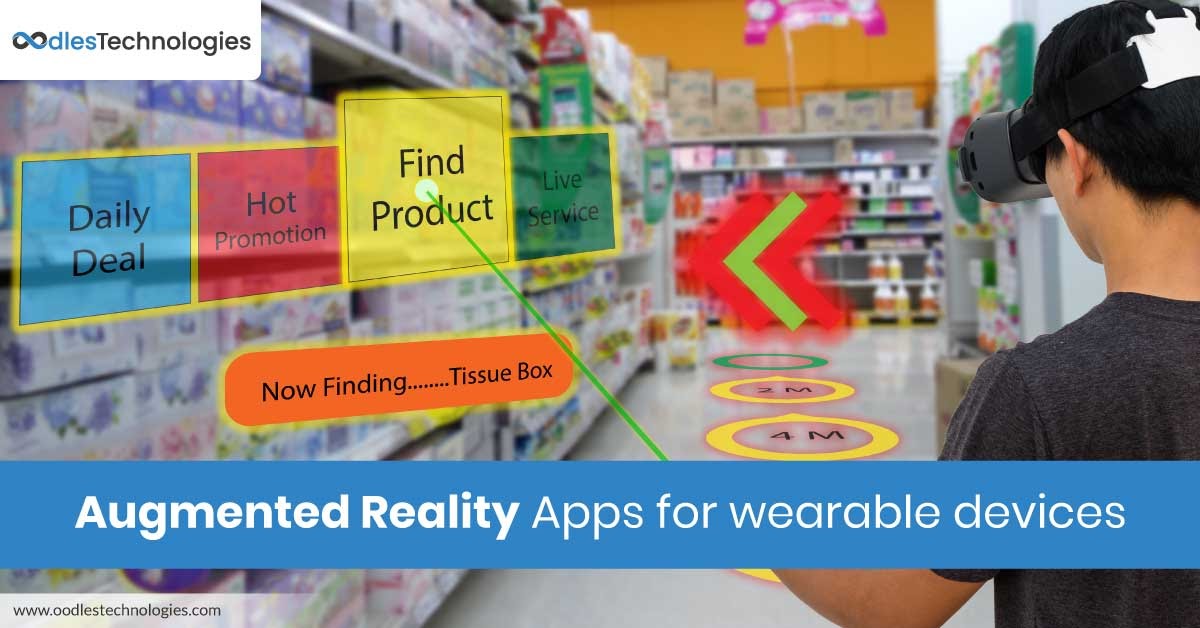
Benefits of Integrating AR with Wearable Technology


The adoption of augmented reality and wearable devices has increased significantly in recent years. Businesses are combining Augmented Reality (AR) and wearables to create innovative advertisements and influence customers. These technologies focus on establishing a deep emotional connection with the customer's products, brands or services.

According to eMarketer research, 68.7 million people will use augmented reality at least once per month in 2019. With the growing demand of AR Application Development Services, it is estimated that its reach will extend to 85 million users by 2021.  


Industries where wearables devices and AR is Beneficial  

Healthcare: Grand View Research, a market research and consulting company in the U.S., states, global healthcare market for VR and AR is estimated to grow $5.1 billion by 2025.” 
The first VR operation performed at the Royal London Hospital in the UK enabled doctors to remove cancerous tissue using a VR camera. VR operation enabled medical students to witness a live operation and receive some useful tricks on outperforming their tasks.  
An example of AR in surgery: Colorectal surgeon, Professor Shafi Ahmad, at St Bartholomew’s Hospital in London, used Microsoft’s HoloLens VR headset to virtually bring together worldwide surgeons to operate on a patient. 

 
Education:  Making students interested in learning a subject is often the most difficult task for educators. Augmented reality takes students on an immersive virtual tour to get them interested in learning different topics,  subjects and more. AR is one of the experiential learning techniques that maximize student motivation and engagement through interactive visuals. 

Manufacturing: AR, wearable cameras and smart glasses can influence the manufacturing system in factories. A combination of AR and wearables technologies can be used for assembling, maintenance, manufacturing, training, logistics management, and quality assurance. Interactive visuals produced with AR can accelerate manufacturing processes. The two technologies enable technicians to look up schematics and accelerate their work in real-time. For instance, the AR app can demonstrate a worker with smart glasses on how a particular machine part will fit in the final construction. 

Entertainment: Media, entertainment, and communication sectors are ripe for wearable technology. Wearable technology can make 7D movies more impactful with tactile features and provide better mechanisms to generate video content 

 
Wearables devices and AR will continue to transform the entertainment, media, health, and fitness industries. Businesses are now investing in android wearable app development services, messaging wearable apps, notification apps, wearable music apps and more. Also, retail businesses can use wearable technology to enhance the customer experience. 

Are you planning to use AR technology and wearable devices to improve processes and productivity? Contact ourAR VR app development experts at Oodles Technologies. We are a renowned AR app development company in India that builds robust and feature-rich applications for enterprises across the globe. We also provide Wearable app development services for smartwatches, fitness bands, iWatch and more. Apart from AR app development solutions, our developers provide solutions using next-gen technologies like machine learning, ERP, mobile, Virtual reality, mixed reality, big data, DevOps and cloud solutions. Contact our experts today for more details!