Showing posts with label DevOpsSolutions. Show all posts

Tuesday, June 30, 2020

An Introduction To DevOps Processes and Their Significance


In traditional software development methodologies, the time taken for code deployment was a major setback. One of the main reasons for slower code deployment was the lack of consistency between the development and the operations teams. To bridge this gap, the concept of DevOps came into action.

DevOps solutions and services provide continuous monitoring and integration of the tasks being performed by development and operations teams. It brings developers and operations experts under the same roof to improve the efficiency of IT processes. DevOps is increasingly becoming popular amongst IT companies because it helps them effectively meet the dynamic requirements of the IT infrastructure.

What Is DevOps?

DevOps is a software development strategy that bridges the gap between the development and operations teams. It is a set of practices that works to automate and integrate the processes between software development and IT infrastructure management. As a result, it streamlines the entire workflow so they can build, test, and release software faster and more reliably.
 

How It works?

DevOps is a philosophy that involves both development and operations teams to work together throughout the project development lifecycle. From product design to its release and support, DevOps ensures accelerated processes with a focus on continuous delivery and continuous integration. It unites several effective tools like Agile, Git, Gradle, Jenkins, and more to accelerate the software development lifecycle and reduce time-to-market. 

Let’s discuss DevOps processes and explore the DevOps roadmap in detail through the following stages:

Planning

This is the first stage where the DevOps teams discuss the project goals and requirements with their clients and formulate an execution strategy.

Coding

Once the plan is finalized, the programmers can design and code the application. With tools like Git, developers have a repository to store all the codes and their different versions. It helps them work on the same codebase rather than working on bits of code for different operations.

Build

In this stage, the codes from different repositories are combined to build the complete application. Tools like Maven and Gradle enable developers to execute this process.

Testing

Before its deployment, the application is tested using automation tools like Selenium and JUnit to detect and fix bugs that are essential to ensure software quality.

Integration

It is the core of the DevOps working cycle that makes this methodology so effective. Tools such as Jenkins enable developers in the process of sending the codes for building and testing. When the testing is complete, it is further sent for deployment. This process is called continuous integration.

Deployment

In this stage, the application is packaged after release and deployed from the development server to the production server.

Operation

Once it is successfully deployed, the operations team configures the servers, provisioning them with the required resources. Tools such as Chef, Docker, and Ansible are effective at operating and managing various productions.

Monitoring

Every product is continuously monitored in its own working environment. Continuous monitoring enables IT companies to identify specific issues with various releases. It helps them understand the impact of their product on end-users, thus providing the best possible solution for each client.

Benefits

Collaboration and Trust

It is one of the most important elements of the DevOps culture as it brings both development and operation teams to work in collaboration. In doing so, they can establish a culture of shared responsibility, transparency, and faster feedback.

Improved Defect Detection

The development team designs and develops each block of functionality of an application. Then the application is immediately tested and taken over by the operations team for finalizing the deployment process. Working cohesively makes it easier to detect any loopholes that may arise in the process and to increase the stability of the platform.
 

Accelerate Time to Resolution

DevOps teams are equipped with fully transparent and seamless modes of communication. As a result, they are able to resolve critical issues in less time without any frustration between the development and operations teams. DevOps teams can discuss the issues freely, fix the bugs, and solve the matters faster and more efficiently.
 

Increased Effectiveness

DevOps offers a combination of several tools and effective practices that enables IT companies to automate testing, deployments, and provisioning of services. It lets them reduce repetitive tasks and allows them to focus on their core operations. At the same time, it ensures higher productivity at work and aids in delivering higher quality outputs.

You may also be interested in reading The Significance of DevOps For Technology Companies

Conclusion

DevOps is an approach to development that revolves around the concept of collaboration. Its main idea is simply the cohesive working of the development and operations teams for enhancing the quality of end-products. It is an evolution of the agile methodology. In addition, DevOps services enrich the development process through continuous configuration, delivery, monitoring, and continuous integration.
 

Why Choose Oodles Technologies For DevOps Consulting Services?

We are an accomplished software development company that specializes in providing DevOps solutions and services to accelerate and improve the software development lifecycle. Our experienced team of developers and operations experts work together to meet the client’s requirements through DevOps. Our DevOps professionals are skilled at using various tools and practices to produce optimum results.

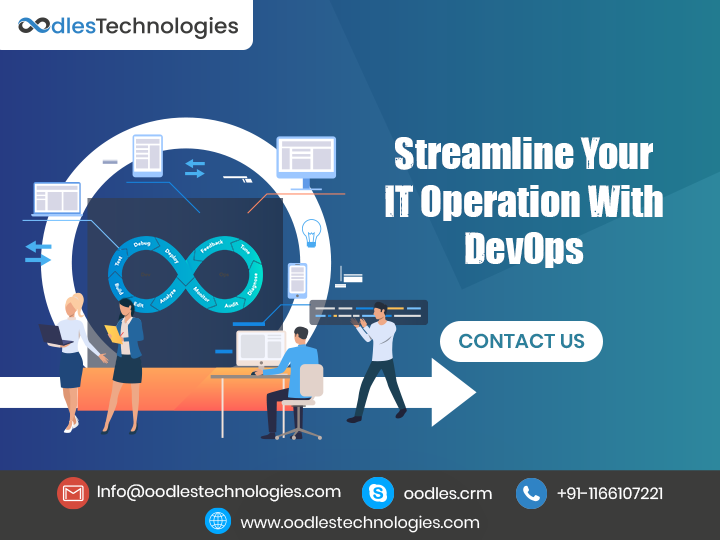
Thursday, June 11, 2020

Devops consulting services

102393214_3064013170324117_3369443632601235455_n (1)

Avail our DevOps consulting services to drive your business intelligently with streamlined, agile, and automated IT operations
Our end-to-end

DevOps services

enable businesses to accelerate their development cycle and strike a perfect balance between development and IT operations. We are a seasoned

 DevOps service provider company

that streamlines the software development processes like planning, analysis, design, development, testing, integration, and maintenance. Our DevOps solutions improve work culture through lean and agile principles, remove development bottlenecks through a highly fluid and collaborative environment, enable responsive feedback mechanism, enhance operational performance, and thus foster innovation. Ready to gain DevOps consulting service benefits?. #bethenext.
 

DevOps Consulting Services To Modernize Your Enterprise Systems

Improve software efficiencies and streamline your IT processes with our 360-degree DevOps services

Infrastructure Assessment and Management

Our initiation process enables stakeholders to comprehend the DevOps scope in every layer of the organization. Our

DevOps consulting services

assist enterprises to set up DevOps structure, recommend tools, and bring automation in every stage of the delivery lifecycle.
  • Assessment of existing infrastructure
  • Identification of the right tools
  • Align organization ecosystem
  • Organize individual and application clusters
  • Alignment of business objectives
  • Govern operating models

Continuous Deployment

We make your code deployable at anytime by minimizing manual tasks through automating repetitive tasks, eliminating DIY by adopting unified pipeline, making deployment frictionless through harmonious workflow, and hence enhancing overall productivity.
  • Automated testing phases at each stage of development
  • Faster troubleshooting owing to access for all tools and process
  • Meaningful collaboration between developers, quality analysts, operation team, and testers
  • Maintain continuous delivery pipeline without manual intervention
  • Respond to market opportunities by providing valuable solutions
More info at -  https://www.oodlestechnologies.com/devops-consulting-services/

Wednesday, November 13, 2019

Choosing An Ideal DevOps Tool to Accelerate Development


The amalgamation of the development and operations (DevOps) team has enabled businesses to improve their software development life cycle(SDLC). Selecting the right DevOps tool maximizes the collaboration and communication between the development and operations teams. 

Here are some best DevOps tools we use to support automation and collaboration between development and operations team. 

  1. Gradel: Introduced in 2009, Gradel enables a software developer to write code in Java, Python, C++, and other languages. 

Popular Features: 
  • Popular IDEs like Eclipse, IntelliJ IDEA, and Netbeans support Gradel 
  • Google chose Gradel as an official build tool for Android Studio
  • Uses Groovy-based DSL to describe builds
  • Availability of Kotlin-based DSL enables mobile app developers to write build scripts in Kotlin
  • Uses Maven’s repository format, so dependency management is similar for developers with prior Maven experience
  • Supports import of Ant builds
  • Gradle’s incremental builds save compilation time
  • 100 times faster than Maven 
2. Git: The next on the popularity list is Git, used widely across the software development industry. 
Popular Features
  • Distributed SCM(Source Code Management) Tool suitable for open source contributors and remote teams
  • Enables tracking of mobile app development work
  • Facilitates switching from one source code to the other


To Integrate Git with DevOps workflow, businesses have to host repositories to enable the teams to accelerate software development. GitHub and Bitbucket are the two best GiT repositories available with easy integrations. 
  
GitHub- Access available for public repositories for free. Suitable to accomplish Git projects. 
Bitbucket- Available with free unlimited private repositories for small teams 


3. Jenkins- A leading DevOps automation tool designed to accelerate SDLC. 
Popular features
  • CI/CD server enables developers to automate different stages of the delivery pipeline. 
  • Availability of more than 1000 plugins support integration with different DevOps tools including Docker and Puppet
  • Easy to customize and set up CI/CD pipeline based on business-specific requirements
  • Easy to get started with and performs exceptionally great on Windows, Mac OS X, and Linux
  • Easy to install with Docker
  • Easy to set and configure through a web interface
  • Iterates and deploys new codes quickly
  • Facilitates measurement of each step of the development pipeline
4. Bamboo- The Choice of professional teams for continuous integration, deployment, and delivery and works similar to Jenkins.  
Popular Features:
  • An open-source tool facilitates developers to automate different stages of the delivery pipeline including builds and deployment 
  • Easy to use pre-built functionalities and 100+ plugins support integration with different DevOps tools 
  • Facilitates seamless integration with Jira and Bitbucket
  • Available with intuitive UI, tooltips, auto-completion, and other handy features.
  • Provides access to built-in Git and Mercurial branching workflows and test environments.
5. Docker- Launched in 2013, Docker has made containerization popular in the tech world. 
Popular Features
  • Operating System and Platform Independent
  • Automates deployment of apps and makes distributed development possible 
  • Isolates apps into separate containers, making them secure and portable
  • Docker containers can be used instead of virtual machines like VirtualBox.
  • Dependencies can be packed within the app’s container and shipped as an independent unit to run apps on different platforms 
  • Integrated seamlessly with Bamboo and Jenkins to improve delivery workflows
  • Ideal for cloud computing- Added by AWS and Google Cloud 
6. Kubernetes- Released in 2015 by Google Engineers, Kubernetes is an open-source container orchestration platform to automate deployment, scaling, and management of containerized applications.  
Popular Features
  • Facilitates grouping of containers into logical units
  • A logical step towards finding a solution to development complexities and scaling resources
  • Enables developers to automate the process of managing hundreds of containers.
  • Deployed to a cluster of computers to eliminate tying with containerized apps 
  • Automates the distribution and scheduling of containers across the whole cluster
  • Kubernetes cluster has a master and several worker nodes. The master node executes developers' pre-defined rules and deploys containers to the worker nodes. 
  • Evenly Redistributes the containers when the worker node is down. 
7. Puppet Enterprise- A cross-platform configuration management platform.
Popular Features 
  • Automates infrastructure management to accelerate the delivery of software 
  • Facilitates the management of infrastructure as code. 
  • Provides an additional open-source tool to accomplish small projects
  • Puppet Enterprise extra features like Real-time reports, Role-based access control, and Node management support large enterprises 
  • Manages multiple teams and thousands of resources
  • With more than 5000 modules, Puppet integrates flawlessly with other DevOps tools

8. Ansible- a Configuration management tool that works similar to Chef and Puppet. 
Popular Features 
  • Simple and easy to use
  • Configures infrastructure and automates deployment
  • Infrastructure as Code approach is same as Puppet
  • Uses the super simple YAML syntax to define tasks 
  • Agentless architecture since no daemons or agents run in the background
  • secure and lightweight solution for configuration management automation
  • several modules integrate flawlessly with other DevOps tools 

Choosing a right DevOps tool requires testing and experimentation. It usually takes more time to set up and configure open-source tools. Commercial DevOps tools come with free trials to enable developers test and evaluate the right one.

Planning to deploy a DevOps tool that supports automation and collaboration between teams? We are an established DevOps consulting service company. Click this link to talk to our experts today!