Showing posts with label softwaredevelopment. Show all posts

Thursday, July 9, 2020

Create P2P connections with WiFi Direct in android

What is Android Wi-Fi P2p APIs?
It allows nearby devices to connect and communicate among themselves without needing to connect to a network or hotspot.

Advantages over traditional Wi-Fi ad-hoc networking?
  • Wifi-Direct supports WPA2(Wifi Protected Access) encryption.
  • Android doesn't support Wi-Fi ad-hoc mode.

Let's implement : 

Set up application permissions :
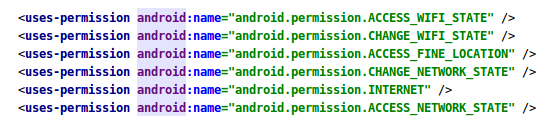
Set up a broadcast receiver :
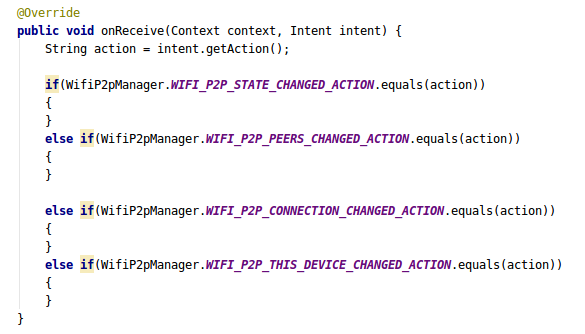
With the help of broadcast receiver we will be able to listen various phases of connections between 2 devices.
Constructor of broadcast receiver class : 

The onReceive() method of broadcast will look like this : 
Create an activity and register broadcast receiver : 
1- Create intent Filter : 
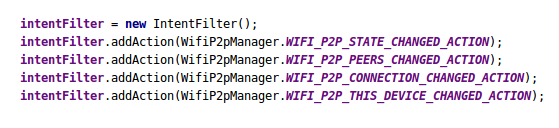
 
WifiP2pManager.WIFI_P2P_STATE_CHANGED_ACTION : Indicates a change in the Wi-Fi P2P status.
WifiP2pManager.WIFI_P2P_PEERS_CHANGED_ACTION : Indicates a change in the list of available peers.
WifiP2pManager.WIFI_P2P_CONNECTION_CHANGED_ACTION : Indicates the state of Wi-Fi P2P connectivity has changed.
WifiP2pManager.WIFI_P2P_THIS_DEVICE_CHANGED_ACTION : Indicates this device's details have changed.


2- Register receiver in OnCreate : 

Listen to broadcast receiver :

1- Now when you run the application you will find that your control will get to the WIFI_P2P_STATE_CHANGED_ACTION, so this the point where you will start finding the peers(nearby you) if your WIFI state is enabled.
So in your broadcast receiver check the wifi-state and start listen for peers if it is enabled.


And your startFindPeers method will look like this on Activity : 
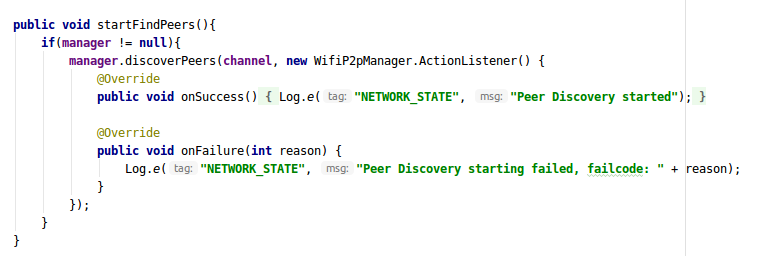

2- As soon as you successfully discover the nearby peers the WIFI_P2P_PEERS_CHANGED_ACTION in your broadcast receiver class gets trigerred, so this is the point to get the list of all the available devices.
So, inside your broadcast onReceive method and add the following code in WIFI_P2P_PEERS_CHANGED_ACTION and register your peer callback : 
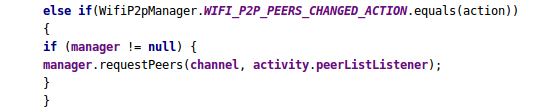

This requestPeer() method is implicitly provided by WifiP2pManager class but this peerListListener is custom and is used to as a callback for peerList : 
PeerListener will be like this : 

3- Now if the call is successful then you will get the list of all available devices with various other parameters in onPeersAvailable, iterate through the list and select one device to connect.
Now next step is to get the peer configurations of the selected item in the peerList and connect with peers using deviceAddress : 
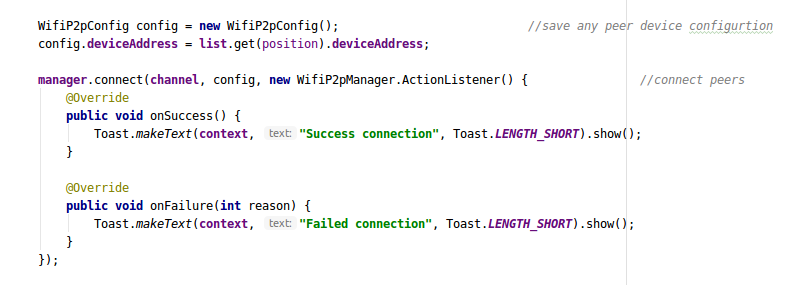
   

4- Once we get the successfull connection with the peer the WIFI_P2P_CONNECTION_CHANGED_ACTION is trigerred and this is the point to get the connection info from the connectionListener callback.
 The connection info can be get by passing connection callback as a parameter in requestConnectionInfo() method.
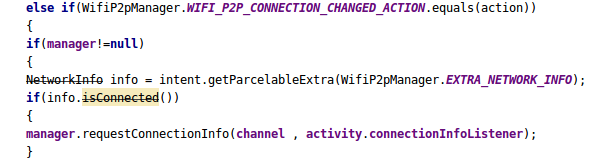
And the connectionInfoListener will look like this :
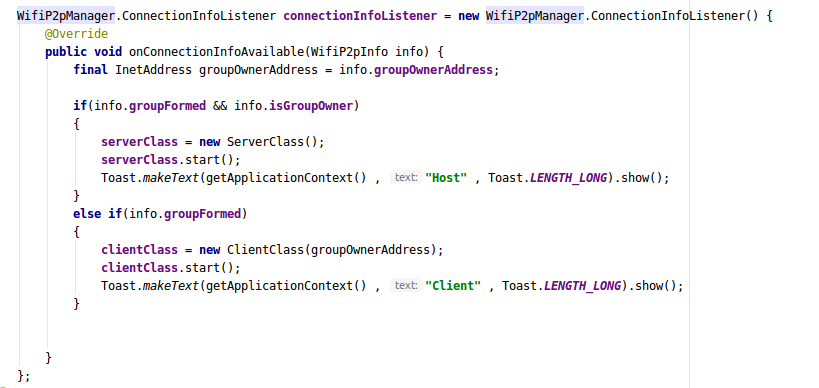

Great our peers are now connected to each other and can transfer data between themselves.

5- To transfer the data you have to create a client and server class based on available connection info.
Let's take a look at server class  : 
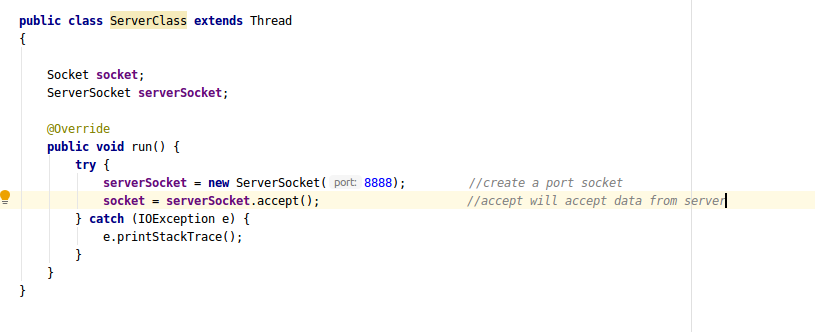
This is the client class : 
So finally, the sockets are now connected to each other and data transfer can be done easily using input and output streams of the socket.

We are a seasoned SaaS app development company that provides full-scale software solutions using next-gen technologies. Our team of developers is experienced in using the latest tools and SDKs to build performance-driven and user-friendly software solutions for multiple platforms. We also specialize in providing end-to-end DevOps solutions and cloud app development services for varied business requirements. For technical assistance, contact us at info@oodlestechnologies.com and share your requirements.

Thursday, June 11, 2020

Devops consulting services

102393214_3064013170324117_3369443632601235455_n (1)

Avail our DevOps consulting services to drive your business intelligently with streamlined, agile, and automated IT operations
Our end-to-end

DevOps services

enable businesses to accelerate their development cycle and strike a perfect balance between development and IT operations. We are a seasoned

 DevOps service provider company

that streamlines the software development processes like planning, analysis, design, development, testing, integration, and maintenance. Our DevOps solutions improve work culture through lean and agile principles, remove development bottlenecks through a highly fluid and collaborative environment, enable responsive feedback mechanism, enhance operational performance, and thus foster innovation. Ready to gain DevOps consulting service benefits?. #bethenext.
 

DevOps Consulting Services To Modernize Your Enterprise Systems

Improve software efficiencies and streamline your IT processes with our 360-degree DevOps services

Infrastructure Assessment and Management

Our initiation process enables stakeholders to comprehend the DevOps scope in every layer of the organization. Our

DevOps consulting services

assist enterprises to set up DevOps structure, recommend tools, and bring automation in every stage of the delivery lifecycle.
  • Assessment of existing infrastructure
  • Identification of the right tools
  • Align organization ecosystem
  • Organize individual and application clusters
  • Alignment of business objectives
  • Govern operating models

Continuous Deployment

We make your code deployable at anytime by minimizing manual tasks through automating repetitive tasks, eliminating DIY by adopting unified pipeline, making deployment frictionless through harmonious workflow, and hence enhancing overall productivity.
  • Automated testing phases at each stage of development
  • Faster troubleshooting owing to access for all tools and process
  • Meaningful collaboration between developers, quality analysts, operation team, and testers
  • Maintain continuous delivery pipeline without manual intervention
  • Respond to market opportunities by providing valuable solutions
More info at -  https://www.oodlestechnologies.com/devops-consulting-services/

Wednesday, November 13, 2019

Choosing An Ideal DevOps Tool to Accelerate Development


The amalgamation of the development and operations (DevOps) team has enabled businesses to improve their software development life cycle(SDLC). Selecting the right DevOps tool maximizes the collaboration and communication between the development and operations teams. 

Here are some best DevOps tools we use to support automation and collaboration between development and operations team. 

  1. Gradel: Introduced in 2009, Gradel enables a software developer to write code in Java, Python, C++, and other languages. 

Popular Features: 
  • Popular IDEs like Eclipse, IntelliJ IDEA, and Netbeans support Gradel 
  • Google chose Gradel as an official build tool for Android Studio
  • Uses Groovy-based DSL to describe builds
  • Availability of Kotlin-based DSL enables mobile app developers to write build scripts in Kotlin
  • Uses Maven’s repository format, so dependency management is similar for developers with prior Maven experience
  • Supports import of Ant builds
  • Gradle’s incremental builds save compilation time
  • 100 times faster than Maven 
2. Git: The next on the popularity list is Git, used widely across the software development industry. 
Popular Features
  • Distributed SCM(Source Code Management) Tool suitable for open source contributors and remote teams
  • Enables tracking of mobile app development work
  • Facilitates switching from one source code to the other


To Integrate Git with DevOps workflow, businesses have to host repositories to enable the teams to accelerate software development. GitHub and Bitbucket are the two best GiT repositories available with easy integrations. 
  
GitHub- Access available for public repositories for free. Suitable to accomplish Git projects. 
Bitbucket- Available with free unlimited private repositories for small teams 


3. Jenkins- A leading DevOps automation tool designed to accelerate SDLC. 
Popular features
  • CI/CD server enables developers to automate different stages of the delivery pipeline. 
  • Availability of more than 1000 plugins support integration with different DevOps tools including Docker and Puppet
  • Easy to customize and set up CI/CD pipeline based on business-specific requirements
  • Easy to get started with and performs exceptionally great on Windows, Mac OS X, and Linux
  • Easy to install with Docker
  • Easy to set and configure through a web interface
  • Iterates and deploys new codes quickly
  • Facilitates measurement of each step of the development pipeline
4. Bamboo- The Choice of professional teams for continuous integration, deployment, and delivery and works similar to Jenkins.  
Popular Features:
  • An open-source tool facilitates developers to automate different stages of the delivery pipeline including builds and deployment 
  • Easy to use pre-built functionalities and 100+ plugins support integration with different DevOps tools 
  • Facilitates seamless integration with Jira and Bitbucket
  • Available with intuitive UI, tooltips, auto-completion, and other handy features.
  • Provides access to built-in Git and Mercurial branching workflows and test environments.
5. Docker- Launched in 2013, Docker has made containerization popular in the tech world. 
Popular Features
  • Operating System and Platform Independent
  • Automates deployment of apps and makes distributed development possible 
  • Isolates apps into separate containers, making them secure and portable
  • Docker containers can be used instead of virtual machines like VirtualBox.
  • Dependencies can be packed within the app’s container and shipped as an independent unit to run apps on different platforms 
  • Integrated seamlessly with Bamboo and Jenkins to improve delivery workflows
  • Ideal for cloud computing- Added by AWS and Google Cloud 
6. Kubernetes- Released in 2015 by Google Engineers, Kubernetes is an open-source container orchestration platform to automate deployment, scaling, and management of containerized applications.  
Popular Features
  • Facilitates grouping of containers into logical units
  • A logical step towards finding a solution to development complexities and scaling resources
  • Enables developers to automate the process of managing hundreds of containers.
  • Deployed to a cluster of computers to eliminate tying with containerized apps 
  • Automates the distribution and scheduling of containers across the whole cluster
  • Kubernetes cluster has a master and several worker nodes. The master node executes developers' pre-defined rules and deploys containers to the worker nodes. 
  • Evenly Redistributes the containers when the worker node is down. 
7. Puppet Enterprise- A cross-platform configuration management platform.
Popular Features 
  • Automates infrastructure management to accelerate the delivery of software 
  • Facilitates the management of infrastructure as code. 
  • Provides an additional open-source tool to accomplish small projects
  • Puppet Enterprise extra features like Real-time reports, Role-based access control, and Node management support large enterprises 
  • Manages multiple teams and thousands of resources
  • With more than 5000 modules, Puppet integrates flawlessly with other DevOps tools

8. Ansible- a Configuration management tool that works similar to Chef and Puppet. 
Popular Features 
  • Simple and easy to use
  • Configures infrastructure and automates deployment
  • Infrastructure as Code approach is same as Puppet
  • Uses the super simple YAML syntax to define tasks 
  • Agentless architecture since no daemons or agents run in the background
  • secure and lightweight solution for configuration management automation
  • several modules integrate flawlessly with other DevOps tools 

Choosing a right DevOps tool requires testing and experimentation. It usually takes more time to set up and configure open-source tools. Commercial DevOps tools come with free trials to enable developers test and evaluate the right one.

Planning to deploy a DevOps tool that supports automation and collaboration between teams? We are an established DevOps consulting service company. Click this link to talk to our experts today!

Monday, October 14, 2019

Cloud Based DevOps to Accelerate Software Development


Cloud-Based DevOps

Integration of DevOps with Cloud has opened opportunities for software development companies to shorten their software development life cycle (SDLC) with agility. The collaboration of Cloud and DevOps enables software developers to accelerate software development,  deliver fixes, features, and updates instantly. DevOps and Cloud enable mobile app developers to automate tasks including planning, analysis, design, development, testing, deployment, and production. 


We at Oodles, use Cloud-based DevOps solutions including AWS, Google Cloud, and Azure to accelerate software development and configuration, container management, integration, and deployment. 


Let’s explore the benefits of DevOps Cloud Services in the software development life cycle(SDLC): 

Centralized platform: The centralized nature of cloud computing provides a centralized and standard platform for DevOps automation. Cloud-based DevOps addresses the shortcomings of the water-fall method to meet the requirements of centralized software deployment. 

Amalgamation of Integration and Development: Public and private Cloud platforms support DevOps objectives of continuous delivery (CD) and continuous integration (CI) to reduce the cost associated with DevOps automation.  

Tools and Practices
Description
Version control
To track software versions
Build and deploy
Automate software development and deployment. 
Functional and non -functional testing
Automate testing
Provisioning and change management
Provide platform and track changes 

The shift of Focus : Cloud remote storage capabilities enables organizations to easily manage resources while shifting from the traditional waterfall model to the DevOps concept. 

Improved Scalability:  Cloud-based DevOps increases the scalability of application development. The cloud enables organizations to bypass physical hardware constraints to reduce infrastructure costs and increase global reach. 

Minimized Failure: Industry specialists like Amazon, Google, Facebook, Twitter, etc. rely on DevOps for continuous deployments throughout the day.  Cloud-based DevOps solutions enable organizations to make changes with minimum or no failure without affecting the current workflow. 


Speed to Delivery: The goal of IT organizations is to minimize their time to value. DevOps cloud services strengthen infrastructure and automate workflows to accelerate the delivery of software solutions. It identifies and eliminates risks during the initial stages of the development life-cycle. Cloud-based DevOps enable organizations to adapt to the changes that were previously unachievable.  

 
DevOps cloud computing reduces downtime through continuous cloud-based operations. Our cloud experts build stateless applications to reduce application downtime and maximum customer satisfaction. A combination of DevOps and cloud have removed the gap between development and operations teams. Implementing Cloud-based DevOps solutions enables development and operations teams to work in tandem to optimize developer's productivity and operations reliability.

 
Would you like to achieve flexibility in your software development life cycle? We customize your DevOps-ready private cloud environment to meet your business requirements, achieve efficiency and provide security.  DevOps software development methodologies deliver applications and services with efficiency. Our DevOps model automates and accelerates the processes between software developers and operations teams. The aim of our DevOps consulting services is to improve management processes, decrease cost and deliver end-to-end agility. 

Wednesday, July 31, 2019

Hybrid Mobile App Development Company


We are a 360-degree hybrid MOBILE APP DEVELOPMENT COMPANY that reduces your time-to-market with our cross-platform hybrid app development services. Our team of hybrid mobile app developers is skilled at building secure, scalable, and high-performance business applications with custom features. We use agile methodologies to develop user-friendly hybrid apps that deliver exceptional user experience with attractive visuals and UI/UX designs

We, at Oodles, provide full-scale HYBRID MOBILE APP DEVELOPMENT SERVICES using tech-driven methodologies. Our hybrid mobile app developers are experienced in using the latest development frameworks to build high-performance hybrid apps that support multiple platforms. Our UI/UX design team ensures that your mobile app designs are consistent with your brand image to deliver a better user experience. We also provide hybrid app integration and migration services to fulfill your mission-critical business requirements.

Tuesday, March 19, 2019

SaaS Tricks To Minimize The Cloud Security Risks


With a surge in technological advancements, we are witnessing a major shift in the patterns of security measures. People have now started to put their faith in the cloud and are actively storing data there instead of opting for the traditional methods such as papers and files. Thankfully, the massive concern and requirements of storage platforms have heightened the levels of data security systems.
Software as a Service (SaaS) security is essentially a software framework that is used to secure and protect huge chunks of data stored in the cloud. However, minimizing the cloud security risks with SaaS is not an everyday game and you need to fully understand the features to leverage its true potential. Therefore, in this article, I am sharing few SaaS Security tips that you need to follow in order to safeguard the cloud storage data.
At Oodles Technologies, we provide top-notch SaaS Application Development services for various platforms. We have years of experience in providing outstanding and cost-effective solutions to the clients belonging to different industries. Our firm endeavor is to raise the bar and set high standards for application development. We have vast experience in SaaS Application Development Services. We have been delivering world-class services in web and mobile app development and we strive to deliver best-in-class development services at the best market price.
We also build mobile apps with high scalability and premium-grade performance at the best price. Our proficient developers and passionate designers help in creating a wonderful user experience.

Monday, February 18, 2019

5 DIgital Tech Trends to watch in 2019


Technological progress has influenced the way we connect with the audiences today. The innovation of Smart technology is now influencing the growth of companies. A business with an upgraded technology progresses faster in comparison to the one which lags behind in terms of the technology.  To stay ahead of the rest in the market, companies need to follow the trends listed below. These trends will not only help in keeping them ahead of the rest in the market but will make their operations much faster and cost-effective.

Artificial Intelligence and Chatbots


Chatbots are the upcoming trend in the market. With the help of artificial intelligence, these Chatbots will be able to help companies reduce their operating cost. These Chatbots would offer suggestions to customers in real time. It also creates a human-like experience with the help of machine learning. Customers will be able to find instant solutions without having to wait for a day or two. Instant support from the chatbots will help companies improve their image in front of their customers. With this technological upgrade, customers will be able to order shoes online, make dinner reservations, pay bills, or book an appointment with the doctor. Introduction of chatbots has reduced phone queues in real time.

Trend of Smart Speakers


In digital marketing, voice search plays a very crucial role. When users type a query, they get hundreds of search results. Apple’s voice search is different from the search results of a normal browser. When a question is asked from Siri, the users get limited results. If a company expects itself to be found in these limited search results, they should tailor their SEO strategy for voice search accordingly. This voice search pattern will help improve their Click-Through-Rates (CTR) and keep them top spot in comparison to the competitors in the market.

Wednesday, February 6, 2019

Decentralizing the Internet of Things with Blockchain


Internet of Things is a new age of digitally transformative technologies that are radically changing the world around us. From surveillance to energy networks, from farming techniques to aeronautical applications, there’d be hardly any field that has been untouched with the startling aspects of IoT.

Nevertheless, IoT is creating new opportunities for the companies and individuals all along, providing competitive edge to the businesses and streamlining the workflow of various organizations. It’s only because of the IoT that things are changing so quickly around us. With so many devices connected to the internet today and various gateways on the edge of the network, it is now possible to perform the required actions with minimal or no human intervention at many levels.

Tuesday, February 5, 2019

Ways through which Speech Recognition will impact human lives


Speech Recognition Services has gradually changed in the last few years and will proceed to develop and bolster new applications. We have progressed significantly from identifying discretely spoken words to persistent speech recognition, from identifying words in a little vocabulary to identifying words in an expansive vocabulary, from communicating simple instructions to expressing complicated doubts, and from talking in cautiously constrained conditions to speaking on phones in open areas. Here are a few ways that will show how speech recognition will impact our lives.

Read more info at - https://www.oodlestechnologies.com/blogs/Ways-through-which-Speech-Recognition-will-impact-human-lives